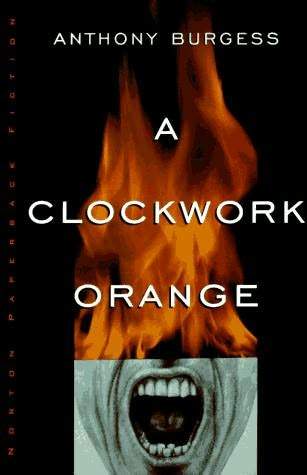
While I’m familiar with Kubrick’s A Clockwork Orange from general pop culture absorption, as well as a film class in college where we watched a few scenes, I’ve never actually watched it. I’ve heard that the author of the novel, Anthony Burgess, hated Kubrick’s film version (and also hated that this book is pretty much what people know him for, despite his many works). So I was excited when my Secret Santa this year got me a copy (thanks narfna!) — I wanted to see what all the fuss was about!
A Clockwork Orange (which, by the way, refers to the idea of something organic being run by something mechanical, and therefore, false) is about a 15 year old named Alex, who runs wild on the streets with his gang, committing various (fairly serious) crimes — assault, burglary, rape, etc. Alex gets caught, and ends up in prison. He’s given the choice to undergo a new rehabilitation program, which will last two weeks, then he could be freed. He agrees, and finds out that the program involves being overloaded with violent imagery and experiences, in the hopes of preventing him from ever committing them again.
First of all, Burgess’s intro to this version, in which he explains that the United States edition never included his final chapter, which wildly changes the tone of the novel, is definitely worth reading. He holds back no emotion, and I loved it. Second — I was not expecting the slang. The characters — particularly Alex and his “droogs” — all speak in this made up slang called nasdat that Burgess (who apparently studied linguistics) created by combining Russian words, cockney slang, and some random nonsense. It takes a bit to get the hang of it — I read the first few chapters while occasionally consulting Wikipedia’s article on the novel — but eventually it felt natural and I found myself kind of enjoying it. Burgess’s ability to create a whole language was pretty impressive.
As for the plot — the violence was, obviously, over the top, and truthfully a bit more than I wanted to deal with. And the treatment seemed very counter-intuitive to me — it was basically immersion therapy, which I would expect to make the subject more comfortable with violence, not less. But the book contains some interesting questions and ideas about good and evil for sure.
Oh, I’m glad you got some enjoyment out of this. It’s a tough book to like (stomach-churning violence), even if you enjoy thinking about it. I didn’t like it all that much the first time I read it, but I read it a couple of times afterwards and for whatever reason, it really resonated with me.
This is one of my favorite books, but the only one in that category that I will never read again*. I loved the idea behind it and the questions it raises. I though the slang was really effective and interesting. But I couldn’t handle the violence. I do think it’s a book that people should read at least once. I’ve never seen Kubrick’s movie, and I have absolutely no desire to see it. The book stands very well on it’s own, and I just don’t see the point in watching the movie.
*TBH- as I get older, I’m curious to see how an older me would react to it. I read it shortly after college, so my early 20s. And I’m curious how I would see it several years later. Which means, despite my proclamation, I may indeed re-read it at some point.