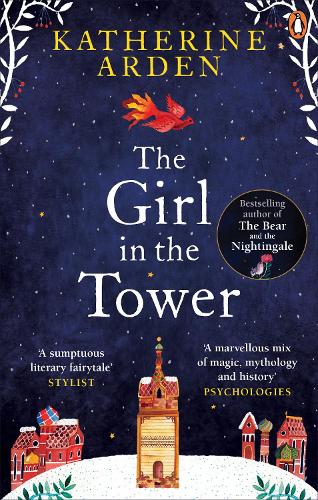
 I read The Bear and the Nightingale earlier this year when winter storms rocked Britain and loved nature’s contributions to the wintry atmosphere. I read the sequel, The Girl in the Tower, in Scotland’s sunniest month (May–somehow it’s always May) and loved this one even more–even if the weather didn’t contribute quite as much to the feel of it!
The Bear and the Nightingale was loosely based on Russian folklore, following Vasilisa Petrovna and her family during a particularly harsh winter, as they fought the forces of evil Death (the Bear) with the aid of the not-as-evil-but-not-entirely-good Morozco, the Winter demon. The Girl in the Tower picks up where the first leaves off, following Vasilisa, or Vasya, on her further adventures. This book focuses more on Moscow and the realms of the political–although don’t worry, it never leaves the magic behind. Vasya meets up with her brother Sasha, a warrior-monk and confidant to the Grand Prince Dmitrii, and with her older sister Olga, who is married to a powerful nobleman. Enemies of Russia are terrorizing the countryside, and Vasya gets caught up in the effort to protect the innocent. The only problem is, she has disguised herself as a boy, and her siblings must play along with the charade or risk their own safety as well as Vasya’s.
I don’t wish to say more, for fear of giving away too much of the gripping plot–or the excitement of the first book as well. I certainly read this one in a day, not wanting to put it down. I will say that the developments in the interactions between Vasya and Morozco felt natural and brought a different tension to this story. Although it is difficult to top the Bear as a villain from the previous book, I think this sequel does an excellent job of bringing the conflict into a different sphere: the political struggles Russia faced from outside its borders. And I may have actually liked the villain of The Girl in the Tower more than the Bear!
The historical-folkloric background to these stories is a delight. Although I adore history, I know very little about Russia’s. Arden does a brilliant job at making the world come alive in a historical sense and infusing it with magic. Vasya’s disguise serves as a way to illustrate the gender dichotomy in medieval Russia, where noble women like Olga live almost entirely separate from men, masters of their household but of little else. By expanding the world of the story to Moscow, far beyond the villages of the first book, Arden is able to grow the story and the conflicts while still retaining the atmosphere she had created with such success.
The minor quibbles I had with the first book were entirely gone in this second, and Arden has really found her stride. I was delighted to see Sasha and Olga back–as much as I liked Vasya’s younger brother and half-sister, the first book spent time setting up Sasha and Olga to be interesting characters, only for them to not be of any importance to the events of the book. They get their time to shine here, and they also solve some of the minor things I didn’t like about the first book. For example, I feel as though there is a more nuanced interaction between Christianity and the old folklore here–Sasha is a man of God but also one of the most likable characters, whereas Father Konstantin from the first book (who makes a reappearance here) was less so, giving the (to me) less interesting impression of a world where Christianity was pitted against the old ways. Additionally, Vasya’s disguise was given a nice counterpoint by having Olga as a character who does not fight against the role her world has set out for her but uses her influence within this world.
I must say that I find it very refreshing that Vasya does not really ‘do’ magic, but relies upon Morozco’s magic–and of course, her ability to see the magic inhabitants of her world where others cannot. Although some call her a witch, this epithet is more about her place in the world–an outsider due to her gender, her sympathies, and her personality–than any magical ability. Her actual abilities, such as her skill with horses, were well set-up in the first book and make sense for her character rather than being preternatural. And of course, she is admirable for her strength of character, for her convictions, and her unwillingness to compromise on what she sees as the right thing to do. (Being a girl who grew up with horses, I also adore that Vasya’s horse Solovey, the ‘Nightingale’, is a character in his own right.)
I eagerly await the third installment of the Winternight trilogy. However, I am willing to wait until January next year… if only because I hope to read it when snow lies thick upon the ground.
So I can’t actually read this because this is sitting on my Kindle, but I read and reviewed The Bear and the Nightingale last month and loved it so much so I am very encouraged by the 5 stars!
I’ve tried to keep my review spoiler-free, but it of course depends on your threshold for spoilers! If you are an absolute spoiler-free purist and don’t want to know what characters are in it, then definitely don’t read, but I haven’t given away any plot details that aren’t revealed in the first quarter of the book. :)
I hope you get to read it soon… I’ll try to keep an eye out for your review!
I love your user name! When I started as a history major in undergrad, I wanted ancient history to be my primary focus but it ended up being easier to fit American history classes into my schedule so I only had enough classes for it to be my secondary focus (it was actually categorized as ancient/medieval but that was when I was not interested in medieval history because I associated it with very strict Christianity while now I am fascinated by the period).
Thanks! I actually went overseas to study because most US universities/colleges don’t really have big Classics/Ancient History departments. Three degrees down and I’ve never regretted it! :)
I’m Catholic and I think I gravitated towards ancient history for similar reasons–I was educated from a very Christian perspective in history and I think it was easier to avoid the question at uni rather than engage openly in ideas of belief vs. historicity. I ended up writing my PhD partly on Constantine (my gravatar is Constantine’s wife) but Christianity still featured as little as possible! The evolution of Christianity in the late antique and early medieval worlds is really fascinating, though, as you say (even if I haven’t studied it in as much detail as the politics!)