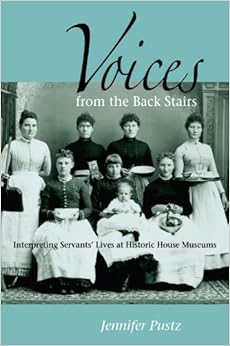
In an attempt to get back to the full cannonball this year, I am including books I read for work. With that, I bring you Interpreting Servants’ Lives at Historic House Museums by Jennifer Pustz. This book grew out of Ms. Pustz’s dissertation and seeks to understand when, why and how domestic staff and servants are being interpreted in the Historic House museum field, and how museum professionals can expand their current offerings to offer a wider, and hopefully more accurate, view of the lives lead by all the people associated with our sites. This book is timely for me, as I am in the process of crafting several programs for our 2014 season around the servants and staff that formed the backbone of our site. And, from the 6 pages of handwritten notes I have on the topic, I think for the most part Ms. Pustz achieved her goals.
Voices from the Back Stairs is broken up into several chapters, which really function more as sections. In the first half of the book we are introduced to the state of things now, based on the research done by Ms. Pustz as part of her dissertation. Ms. Pustz sent out highly detailed questionnaires to sites asking seeking to understand where we are as a field in relation to the bringing this aspect of social history to light. Ms. Pustz doesn’t shy away from exploring how Historic House Museums have evolved over the past quarter century, nor does she shy away from the various reasons many staffs are hesitant to discuss servants. What follows are photo essays about the servant problem, a late 19th century and early 20th century term for the difficulty in finding and retaining good help, and what contemporary interpretation of domestic service looks like today in some of the best exemplars in our field. The second half of the book focuses on using the question of the servant problem to frame interpretation of the site, and providing case studies of sites that are interpreting servants in varying manners to provide inspiration for those of us on the uphill climb.
While this book was at times a bit dry (I found myself counting pages to the wonderful photo essays several times) there are perhaps few people who are more qualified to write a work of this type than Jennifer Pustz. She holds a Ph.D. in American Studies and has worked as a historian in historic house museums for more than a decade at the time of this book’s publication in 2010 and conducts and presents research as part of her day to day work. She has also spent more than a decade researching the servant problem and domestic service interpretation at Historic House Museums.
Voices from the Back Stairs was an easy read once you got going and I particularly enjoyed her discussions of both the history of servants in the United States and her case studies. But perhaps my favorite part of the book was the way she explained how necessary this type of interpretation is to what we do, and I now have a stack of quotes and resources to take to colleagues who may be less than enthusiastic about changes we need to be making. Perhaps the only change I would make would be to shorten the section on the servant problem. I feel Ms. Pustz did a great job of outlining what the problem was, and how it relates to problems that can arise in trying to interpret servant’s lives, but the explanation of how to build a tour or program around the servant problem seemed to drag on for me. This is a book I would recommend to others in my field, even if it was less of a history and more of a best practices guide. I do not however think that the average reader outside of the public history field would be as interested in this work.
This sounds interesting. I feel like lately I’ve seen more things – mostly small articles or references – that try to address the fact that slavery is washed over at plantations and other historical homes, but I hadn’t really seen anything about the servants being ignored. I guess it’s easier to not see that as a gap since they were paid (severly underpaid, I’m sure).
There is a lot of discussion in the book about the hesitation of mostly white staffs to discuss the overt racism that went along with black servants. The book, and research, only cover sites that interpret post 1865, but at that point you stop talking about slavery and start really talking about Jim Crow laws. Its even something that we will need to discuss at our site, since the lady of the house would only hire white and advertised as such.
What the book gets to, and what I know to be true in many sites, is that staff and volunteers often get stuck in the rut of telling the story of the owner, and its at times easier because the historical evidence, the primary sources for domestic staff, are so very difficult to come by. But to me, that’s why its so important. I’m hopeful that as more and more social historians join the public history ranks, we’ll get more done.
Have shows like Downtown Abbey increased the visitors’ interest in the servants?
That same rut has applied to history in general for so long, and it’s really only in the last few decades that people have tried to shift away from the “Great Man” approach. Jill Lepore talks about how that approach still appeals to certain segments of society and how it is part of the modern Tea Party’s approach to history in The White of Their Eyes.
Yes on both counts.
Downton Abbey has increased the interest level significantly and I know of several smaller historic house museums that are currently making huge chunks of their operating budget on ‘Downton Teas’ which focus on having guests served by costumed interpretive staff. Now I’m hoping that we can move past it. This year alone at our site we’re doing a large scale program about the Irish immigrants who worked as servants in the house and on the farm (did I ever mention I work at a Living History Farm?), homeschool programs about servants and farmhands, and twice monthly tours of ‘Maid’s Eye View’ and ‘Cook’s Eye View’ of our historic house.
And oh, the “Great Man” approach. It’s everywhere again, and I really feel that its a backlash to the nearly 30 years of increasing social history which focuses on everyone and everything that supported the ‘great’ men. The travesty that happened with the Texas State Standards a few years back is another prime example. http://www.nytimes.com/2010/03/13/education/13texas.html?_r=0